PLAY! & Schubert’s Third
Third Coast Percussion
Clarice Assad, vocalist & composer
David Danzmayr, conductor
About the Music
Clarice Assad (b. 1978): Suite for Lower Strings
Instrumentation: Scored for string orchestra
Composed: 2009
Duration: 16 minutes
Born in Rio de Janeiro, Grammy-nominated composer and performer Clarice Assad maintains a vibrant global career. Her works have been performed by renowned orchestras and chamber ensembles worldwide, including ProMusica. Her prestigious commissions—from institutions such as the League of American Orchestras, the Oregon Symphony, the Saint Paul Chamber Orchestra, and the Philadelphia Orchestra—attest to her widespread acclaim. As a skilled vocalist and pianist, Assad has shared the stage with legendary artists like Bobby McFerrin and Paquito D’Rivera, and her compositions have been recorded by classical icons including Yo-Yo Ma and Dame Evelyn Glennie.
While much of Assad’s music celebrates her native Brazil, her 2009 Suite for Lower Strings turns toward the European Baroque, drawing heavily on the music of Johann Sebastian Bach.
Designed as a clever reworking of Bach’s most famous themes, listeners will readily spot several iconic melodies throughout the score, including the dramatic opening of the Toccata and Fugue in D minor, heard at the very opening, Jesu Joy of Man’s Desiring, Sleepers Awake, Bach-Gonoud’s Ave Maria and the opening of the First Cello Suite. The most striking portions of the suite, however, are those imbued with the Assad’s inventive, dissonant musical vocabulary, catchy rhythms, and unorthodox percussive effects. As the title suggests, the melodic material traditionally presented by the violins is given over to the orchestra’s lower voices, while the upper strings fill accompanimental roles. Assad also frequently divides up Bach’s melodies among solo voices, thus attaining still greater sonic variation.
Assad: PLAY!
Instrumentation: Scored for pairs of flutes, oboes, clarinets, and bassoons, four horns, two trumpets, two trombones, tuba, timpani, percussion, vocal soloist, percussion quartet, and strings
Composed: 2023
Duration: 25 minutes
Composed in 2023 for the Third Coast Percussion quartet, Clarice Assad’s PLAY! reimagines the traditional three-movement concerto with virtuosity, kaleidoscopic colors, and playful humor. The first movement, “Tick, tock, scrape, pinch, blow, hit, splash, rip,” pays tribute to a variety of composers both past (J.S. Bach) and present (Phillip Glass), in ways that reveal themselves upon the vocalist’s entrance. Rather than singing, the vocalist speaks largely free of strict pitch or meter. In contrast, Assad’s instrumental score for both orchestra and soloists is intricately detailed, filled with shifting meters, precise dynamics, and driving rhythms. Keep an eye on the four soloists, who play, blow, or shake any variety of instruments, from marimbas and wood blocks to less orthodox noisemakers such as the rubber chicken, the thundertube, and the waterphone. As Assad notes, the movement ultimately celebrates “unique visions that lead to magical encounters with kindred spirits.”
Marked “Tenderly,” the middle movement offers a relaxed, atmospheric soundscape floating between cool jazz and late 19th-century Impressionism. “The Hour,” writes Assad, “marks a journey of self-discovery, urging us to embrace inner brilliance and shine in the world.” Over a delicate, lush cushion woven by the orchestra and solo percussionists, the vocalist spins out flowing, ethereal melodies that elevate the movement’s reflective mood.
The finale erupts with syncopated riffs on vibraphone, marimba, and strings, offset by sharp, punctuated jabs from the remaining soloists using squeaky toys, crow calls, and a kung fu fan, while the winds offer support with sustained chords. When the vocalist enters eleven bars in, it does so in the manner of a percussion instrument, with wordless virtuosic passagework. In fact, one might regard the entire ensemble as an orchestra of percussionists, pushing the music ever forward. In the haunting middle section, marked “Undisturbed,” steady ostinato drumming supports an improvised, electro-acoustically processed vocal line (here, Assad calls for a TC Helicon vocal processor). Re-igniting its initial momentum, the movement hurtles forward through an optional soloists’ cadenza and a high-octane orchestral coda, driving the energy straight to the final bar.
Franz Schubert (1797-1828): Symphony No. 3 in D Major
Instrumentation: Scored for pairs of flutes, oboes, clarinets, bassoons, trumpets and horns, timpani and strings
Composed: 1815
Duration: 23 minutes
It’s often tempting to tie a piece of music to its composer’s life story—a connection that holds for works like Beethoven’s “Pastoral” Symphony, which directly reflects his deep love of nature. Hearing Schubert’s Third Symphony in D major, one feels the buoyant energy of a young composer fully confident in his craft; even brief shadows, like the dark turns at the end of the opening phrases, are swiftly brushed aside. Yet behind this radiant score lies a difficult chapter in the eighteen-year-old’s life. In 1815, Schubert was stuck teaching young children at his father’s school, unable to secure a job as a composer, and barred from marrying the woman he loved due to his financial instability. Despite these hardships, the symphony bursts with the pure, exhilarating joy he must have felt whenever he sat down to compose.
Despite these frustrations, 1815 turned out to be the most prolific year of Schubert’s life. He produced over 20,000 bars of music, including 140 songs, nine sacred works, and this symphony. Albert Stadler, a former schoolmate, once described Schubert’s composure while working: “Completely unfazed by the chatter and noise of his fellow students, he sat at his desk writing smoothly and easily, making almost no corrections—as if composing were the most natural thing in the world.” Stadler’s observation hit the mark: writing music was as effortless as breathing for Schubert. While not every piece came so easily, it was certainly true for his Third Symphony, whose manuscript reveals remarkably few traces of effort or revision.
Schubert’s slow introduction plants the seeds for everything that follows. Notice the vivid wind writing, which becomes a central voice throughout the movement, as well as two seemingly minor motifs: a swift ascending scale and a two-note falling figure in the woodwind accompaniment. Though the introduction briefly hints at darkness, the playful clarinet theme opening the Allegro con brio instantly banishes any seriousness. Schubert immediately seizes on the falling two-note motif, turning it into the core of the melody and the oboe-and-horn response. Next, the rising scale returns to usher in a brilliant fortissimo statement from the full orchestra. Following a grand pause, the oboe introduces a second playful theme featuring a dotted rhythmic figure that will soon dominate the development. The movement’s sonata-form structure is easy to track—anchored by dramatic orchestral chords—but two key details stand out. First, Schubert becomes obsessed with the oboe’s dotted rhythm, driving the development forward as the cellos and basses take it over. Second, after the clarinet restates its opening theme to mark the recapitulation, Schubert launches into a second mini-development. While such late-movement development was a trademark of Beethoven, it was highly unusual for Schubert—offering clear proof of the elder master’s influence.
Schubert originally planned for an Adagio to follow the opening movement—his manuscript reveals a few initial bars of a sweeping violin melody—but he abandoned it for a nimble Allegretto. This gem of a G-major movement unfolds in a simple ternary (A-B-A) structure. It opens with a lighthearted violin theme answered by the flute, contrasted by a sparkling clarinet melody. This central section offers a preview of the mature Schubert, evoking the lilt of his famous lied Die Forelle (“The Trout”), which later inspired his celebrated Trout Quintet. Schubert marks the third movement Menuetto Vivace—a clear sign of Haydn’s and Beethoven’s fast-paced minuets influencing the young composer. By placing heavy accents on the third beat, Schubert playfully transforms the once-courtly dance into a rustic, stumbling romp. The contrasting Trio takes the form of a charming Ländler, complete with oboe and bassoon duets that capture the cozy atmosphere of an Austrian country dance.
The finale vaults out of the gate at a breathless Presto vivace, propelled by a galloping motif and a driving 6/8 meter in the opening violins. Schubert utilizes a tripping tarantella rhythm—reminiscent of Mendelssohn’s famous “Italian” Symphony finale, written nearly two decades later. In 1815, however, the eighteen-year-old Schubert sat in Europe’s musical capital, ideas flowing as fast as his pen could move. Rather than relying on contrasting themes, this movement is pure momentum—a study in continuous motion built on a single, exhilarating idea. The drama stems from its harmonic layout: despite the rapid tempo, the bass line moves deliberately, allowing Schubert to harness sudden shifts in dynamics. Starting pianissimo, the music surges to fortissimo in just 17 bars over a three-note bass pattern. After sixteen more bars and only two more chord shifts, the music snaps back to home base in D major, all while a relentless stream of eighth notes sweeps forward. Programmatic or not, the finale evokes a rider galloping across the countryside, constantly urged onward until the final, triumphant chords bring one of Schubert’s most spirited works to a close.
Sadly, the Third Symphony shared the fate of so much of Schubert’s output—it was never performed publicly during his lifetime. In fact, it wasn’t heard in its entirety until 1881, when August Manns, a close friend of the renowned scholar George Grove, conducted it at London’s Crystal Palace. Though it remains somewhat of a rarity on concert stages today, the symphony’s charm, humor, and sparkling grace make it a perfect fit for our lithe little band. Enjoy!
Hans Christian Lumbye (1810-1874): Champagne Gallop
Instrumentation: Scored for piccolo, flute, oboe, two clarinets, bassoon, pairs of horns and trumpets, percussion, and strings
Composed: 1845
Duration: 4 minutes
Though relatively obscure in the United States, Danish composer Hans Lumbye built a lasting European legacy—mostly thanks to his effervescent Champagne Gallop. Written in 1845 for Copenhagen’s Tivoli Gardens, the piece was even featured twice in the Vienna Philharmonic’s prestigious New Year’s Concerts (and lives on as the theme for the Danish TV quiz show Monte Carlo). Beyond the standard array of festive brass and woodwinds, the score calls for two uncommon additions: a xylophone—decades before it became a standard orchestral instrument—and a cork popper, which, regrettably, remains rare in modern percussion sections.
Lumbye’s musical path started early when he joined a military band as a 14-year-old trumpeter, later serving in the Copenhagen Horse Guards. His career truly took off, however, after he encountered the music of Johann Strauss I. Inspired by the Austrian master, Lumbye crafted a celebrated catalog of lighthearted waltzes, polkas, galops, and marches that earned him the moniker “The Strauss of the North.” His music grew so beloved in his home country that proud Danes eventually took to joking that Johann Strauss II was simply the “Lumbye of the South.”
© Marc Moskovitz
marcmoskovitz.org
Your ProMusica Experience
-
Doors open at 6:00 PM.
-
Parking is available directly across Main Street in the Columbus Commons Main Garage.
-
A bar is available for purchase in the lobby, and you are welcome to take your refreshments to your seat.
-
There is no dress code, and all are encouraged to wear whatever makes you feel most comfortable. Some people love dressing up and some prefer to be more casual. Either works!
-
Clap when you like what you hear.
-
The concert run time is approximately 1 hour and 30 minutes, with intermission.
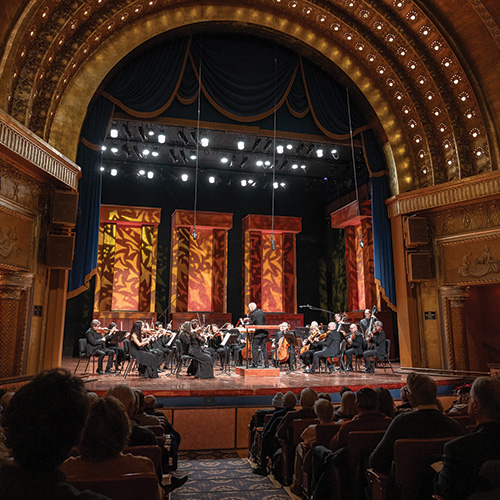
Post Concert
Stay for Coda: Post-Concert Conversation. Meet the featured artists and learn more about the evening’s program.


