
Mozart’s Great Mass
Yulia Van Doren, soprano
Abigail Nims, soprano
Steven Soph, tenor
Kevin Deas, baritone
Columbus Choral Artists
Lynda R. Hasseler, chorus director
David Danzmayr, conductor
About the Music
Wolfgang Amadeus Mozart (1756-1791): Divertimento in D Major, K. 136
Instrumentation: Scored for string orchestra
Composed: 1772
Duration: 15 minutes
In December 1769, a thirteen-year-old Mozart left for Italy with his father, Leopold, who hoped to showcase his son’s extraordinary talent and build valuable connections for the future. Leaving Mozart’s mother and sister at home, the tour stretched over nearly two years. The journey left a lasting mark: Mozart learned Italian, premiered an Italian-inspired opera at the ripe age of 14, and brought home a bright, Italianate sparkle that infused his work for years.
During the winter of 1772, Mozart composed three light, three-movement works in the fast-slow-fast style of the Italian sinfonia, although their exact purpose and intended ensemble size remain unknown. He may have written them as lighthearted string quartets to be played al fresco, or outdoors, or simply for whatever group of musicians he could gather at the time. Though the title “Divertimento” was added later by someone else, it perfectly captures the spirit of these entertaining, Italianate diversions.
The Divertimento in D Major remains a classic among string players for its effortless grace and quintessential Mozartean brilliance. The piece leaps to life with a lively, violin-driven melody over a driving bassline. In the middle section, a shift into a darker minor key eventually gives way to a vibrant moto perpetuo figure in the second violins, anchored by delicate pizzicato accents. The elegant Andante perfectly captures the airy, Rococo charm of an outdoor serenade. Finally, the Haydn-inspired Presto opens with an amusingly simple, six-note call-and-response before launching into a flurry of spirited melodies. The sparkle of Mozart’s first-violin writing will steal your attention, but don’t lose sight—or sound—of the virtuosic second violins! A brief contrapuntal development adds a bit of tongue-in-cheek seriousness to this otherwise captivating and charming youthful work.
Max Richter (b. 1966): On the Nature of Daylight
Instrumentation: Scored for string orchestra
Composed: 2003
Duration: 6 minutes
Born in Lower-Saxony, composer Max Richter came of age and was educated in England. His approachable yet individual musical voice has earned him a place among the most frequently performed of modern composers. As a performer, Richter has embraced the music of minimalists Arvo Pärt, Steve Reich, and Phillip Glass, among others, and the music heard tonight, his six-minute On the Nature of Daylight, mirrors that tradition. The work begins with a ground bass (think Pachelbel’s Canon), a repeating pattern given over to the violas and cellos. Over this pattern, Richter layers the upper strings in simple yet poignant lines that amplify the stoic, melancholy atmosphere of this profoundly moving work. Originally scored for string quintet and subsequently adapted for string orchestra, Richter’s score expresses the fragility of beauty in a violent world. It was composed in protest of the 2003 invasion of Iraq and originally released on the composer’s The Blue Notebooks, an album Richter described as “a quiet protest against the loud rhetoric of war.”
W.A. Mozart: Mass in C Minor, K. 427
Instrumentation: Scored for two sopranos, tenor, and bass; double choir; flute (used only in the Et incarnatus est); pairs of oboes, bassoons, horns, and trumpets; three trombones; timpani; organ; and strings
Composed: 1783
Duration: Approximately 60 minutes
Background & Context
In 1781, a 26-year-old Wolfgang Amadeus Mozart embarked on what would become his celebrated C minor Mass. Having recently relocated from Salzburg to Vienna, he was establishing himself as a premier pianist and composer in Austria’s musical capital. Moving to Vienna also granted Mozart freedom from the Archbishop of Salzburg, under whose employ Mozart had long struggled, and his domineering father, Leopold. Adding to an already fraught relationship with his father, Mozart had also recently decided to marry the singer Constanze Weber without Leopold’s explicit blessing. In late July 1782, Mozart wrote to his father:
“All the good and well-intentioned advice you have sent fails to address the case of a man who has already gone so far with a maiden. Further postponement is out of the question.”
Mozart and Constanze had already moved in together—a bold breach of contemporary social norms. They were married shortly thereafter.
The Mass in C minor was composed against this personal backdrop, but why Mozart turned to such a religious work, at a time when he was primarily focused on composing secular music in Vienna, remains unclear. One reason may have been his recent introduction to the music of Johann Sebastian Bach and George Frideric Handel. The Mass, then, provided the perfect vehicle to experiment with established Baroque choral and contrapuntal techniques. Additionally, it likely served as a reconciliation gesture to his father and native Salzburg. In another letter to Leopold, Mozart cryptically noted:
“I have truly promised this in my heart and hope to fulfill it… a proof of the reality of my promise, however, is the score of half a Mass, of which I have high hopes.”
Mozart fulfilled that promise in October 1783 when the work premiered at St. Peter’s Church in Salzburg, performed by his former court colleagues. Constanze herself sang the virtuosic soprano solos, tailored specifically to her voice. Coming just months after the tragic loss of their first child, her performance likely went a long way toward easing Leopold’s reservations about his new daughter-in-law.
The C minor Mass remains famously incomplete. Only the Kyrie, Gloria, and Benedictus survive in fully realized forms. The Credo breaks off after the Et incarnatus est, and the Agnus Dei is missing entirely. Whether Mozart drew from earlier works for the premiere, left movements unfinished, or had pages lost over time remains a point of debate among musicologists. To present the work in performance, various editors have completed the missing sections. Tonight’s performance features the 1985 edition by Helmut Eder, which completes the orchestration and choral parts for the Credo and Sanctus using Mozart’s extant sketches, deliberately avoiding the addition of a newly composed or adapted Agnus Dei.
Structure of the C minor Mass
| Movement | Section & Tempo Indication | Forces |
| I. Kyrie | Andante moderato | Chorus and Soprano |
| II. Gloria | Gloria in excelsis Deo (Allegro vivace) | Chorus |
| Laudamus te (Allegro aperto) | Soprano II | |
| Gratias agimus tibi (Adagio) | Chorus | |
| Domine Deus (Allegro moderato) | Sopranos I and II | |
| Qui tollis (Largo) | Double Choir | |
| Quoniam tu solus (Allegro) | Sopranos I and II, Tenor | |
| Jesu Christe (Adagio) | Chorus | |
| Cum Sancto Spiritu | Chorus | |
| III. Credo | Credo in unum Deum (Allegro maestoso) | Chorus |
| Et incarnatus est (Andante) | Soprano I | |
| IV. Sanctus | Sanctus Dominus / Hosanna in excelsis (Largo) | Double Choir |
| V. Benedictus | Benedictus qui venit (Allegro comodo) | Vocal Quartet and Double Chorus |
Here are a few thoughts to keep in mind during tonight’s performance:
- Kyrie: Notice how the low brass and choir establish a dark, solemn atmosphere in the opening bars. When the solo soprano enters, the mood shifts dramatically toward an operatic brightness, showcasing the vocal agility Mozart wrote specifically for Constanze.
- Gloria: This movement features intricate, cascading counterpoint (voice against voice). Mozart seamlessly weaves independent lines together—a testament to his mastery of the Baroque fugal style championed by Bach.
- Et incarnatus est (Credo): Listen for the soaring, virtuosic lines in the soprano soloist’s part. One can only imagine Leopold’s reaction to sublime writing for such a gifted singer. Yet, beyond her vocal talent, Constanze proved exceptionally capable in practical matters: after Mozart’s untimely death, she shrewdly managed his catalog and performances of his music, clearing his debts, securing financial independence for her family, and eventually accruing significant personal wealth.
© Marc Moskovitz
marcmoskovitz.org
Your ProMusica Experience
-
Doors open at 6:00 PM.
-
Parking is available directly across Main Street in the Columbus Commons Main Garage.
-
A bar is available for purchase in the lobby, and you are welcome to take your refreshments to your seat.
-
There is no dress code, and all are encouraged to wear whatever makes you feel most comfortable. Some people love dressing up and some prefer to be more casual. Either works!
-
Clap when you like what you hear.
-
The concert run time is approximately 1 hour and 30 minutes, with intermission.
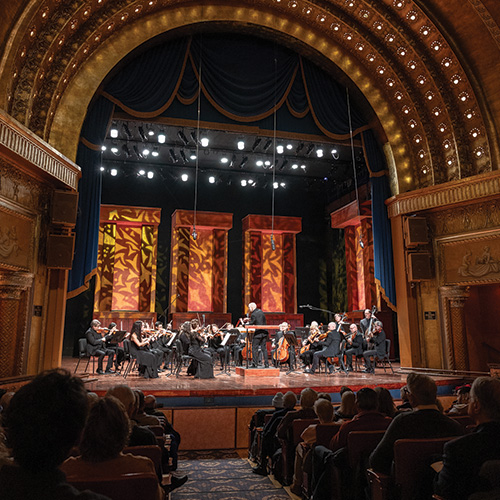
Post Concert
Stay for Coda: Post-Concert Conversation. Meet the featured artists and learn more about the evening’s program.


