Bach, Pärt, & Beethoven
Vadim Gluzman, violin
Katherine McLin, violin
Ken-David Masur, guest conductor
About the Music
Johann Sebastian Bach (1685-1750): Orchestral Suite No. 3 in D Major, BWV 1068
Instrumentation: Scored for strings and harpsicord
Composed: around 1730
Duration: 18 minutes
Bach’s Orchestral Suites are frequently titled Overtures because each opens with a grand movement in the French style. Bach modeled these openings after those of Jean-Baptiste Lully, whose stately, double-dotted rhythms—short-long, short-long—were composed for Versailles to mirror the regal swagger of Louis XIV. Although the four suites feature varying instrumentations, they share a unified framework: a majestic overture followed by a collection of stylized court dances. Bach likely composed this music around 1730 for Leipzig’s Collegium Musicum, an ensemble he directed during weekly Friday evening concerts at Zimmermann’s Coffee House.
Because Bach’s original manuscript is lost, the suite’s intended scoring remains open to interpretation. Surviving parts for trumpet, oboe, and timpani in the hand of his son Carl Philipp Emanuel—along with string parts copied by a student—suggest Bach either enlisted help copying scores or added larger instrumentation for a later performance. Tonight’s performance features an intimate scoring for strings and harpsichord.
The Overture opens with regal grandeur before launching into a lively, fugal middle section, finally returning to a brief reprise of the initial stately tempo. Next is the iconic Air—popularly known as the “Air on the G String” after violinist August Wilhelmj’s 19th-century arrangement. Here, Bach pairs a floating melody with a steady walking bass line to create music of extraordinary, simple beauty. Two lively, French-inspired dances follow: a folk-derived Gavotte and a swift Bourrée featuring a characteristic upbeat entry. The suite closes with a joyful Gigue, a spirited English-style jig in compound meter.
Arvo Pärt (b. 1935): Tabula Rasa
Instrumentation: Scored for two solo violins, string orchestra, and prepared piano
Composed: 1977
Duration: 27 minutes
In the mid-1960s, a group of composers relocated from the West Coast to New York, eager to step away from the post-WWII penchant for complex, hyper-dissonant classical music. Leading figures like Terry Riley and Steve Reich looked to music’s most fundamental elements—simple scales, triadic harmonies, and straightforward rhythmic patterns—to forge a new musical language. Born from this “New York Hypnotic School,” minimalism relied on sparse, consonant material and highly repetitive structures, and quickly built a devoted following. It was from these very ideas that Estonian composer Arvo Pärt found inspiration.
Long before Pärt stripped his own style down to its bare essentials, he had shown a keen openness to external influences. As one of the first Estonian composers to adopt serialism—the complex technique popular after WWII—he achieved early acclaim. Yet by 1968, Pärt hit a profound creative crisis, publishing almost nothing for the next eight years. Instead, he immersed himself in medieval and Renaissance music and converted from Lutheranism to Orthodox Christianity—two key influences that would deeply shape his future aesthetic.
In 1977, at the request of violinist Gidon Kremer, a champion of new music, Pärt composed the double violin concerto Tabula Rasa. The work was so unconventional that even Kremer needed time to grasp its subtle power. Built across two expansive movements, Tabula Rasa was Pärt’s first large-scale piece to feature his signature tintinnabuli style—a slow, meditative approach inspired by minimalist triads that reminded him of ringing bells (tintinnabuli being Latin for “little bells”). The piece marked a major turning point, compelling listeners and performers to hear music in an entirely new way while prompting the ECM record label to launch its acclaimed New Series in 1984.
Though serene on the surface, the piece borders on hypnotic intensity, requiring intense concentration from everyone in the room. The first movement, Ludus (Latin for “game”), unfolds through eight variations of alternating tempos and punctuated silences, building toward a dramatic cadenza for the soloists and prepared piano—an instrument modified with objects placed on the strings to produce unusual, unpianistic timbres. The second movement, Silentium, slows the tempo even further, using a Renaissance technique called prolation, where different musical voices move at distinct, fixed speeds—here, with the lowest voice in the contrabass holding the fastest line and the solo first violin moving at the slowest pace. The movement is organized around the central pitch “D,” and once the movement has played itself out, instruments begin to fade from the scene, until only the contrabass is left, hovering on an E, one step above the central pitch. Pärt omits the final D at the end but rather concludes this fascinating and philosophical work with silence.
Tabula Rasa refers to the Aristotelian concept of a blank slate—a soul unwritten by experience, holding infinite potential. In Pärt’s piece, every single note carries weight; there is nowhere to hide. And as noted above, silence, too, has become an active, integral element of the work. As Pärt has noted:
“Before one says something, perhaps it is better to say nothing. For me, ‘silent’ means ‘nothing’ from which God created the world. Ideally, a silent pause is something sacred… this kind of sublime anticipation is exactly the kind of pause that I value so much.”
Ludwig van Beethoven (1770-1827): Symphony No. 6 in F Major, Op. 68, “Pastoral”
Instrumentation: Scored for pairs of winds (including piccolo), trumpets, horns, trombones, timpani, and strings
Composed: 1802-1808
Duration: 39 minutes
“I love a tree more than a man.” –Ludwig van Beethoven
One would be hard-pressed to find a greater nature lover than Ludwig van Beethoven. As an artist who struggled with personal relationships, he found vital solace in the countryside—a refuge where his mounting loneliness and severe hearing loss could recede. In an 1810 letter to Teresa Malfatti, he confessed, “How fortunate you are to be able to go into the country so soon…I look forward to it with childish excitement. How delighted I shall be to ramble for a while through bushes, woods, under trees, over grass and rocks. No one can love the country as much as I do. For surely woods, trees, and rocks give back the echo which man desires to hear.”
By the time he wrote those words, Beethoven’s hearing had deteriorated dramatically; within a year, public piano performances became impossible. In addition to the burden his loss of hearing placed on his livelihood, it also increased Beethoven’s sense of isolation, and no doubt played into his insecurities and ability to find love or a suitable wife (Malfatti, the recipient of the above letter, was among those women unavailable to the composer). Just how much Beethoven could still hear in 1808, the year of his Sixth Symphony, remains open to debate, though the subtle sounds of nature were by now certainly lost to him. Still, Beethoven held nature’s essence in his mind’s ear. During the spring and summer of 1808, he channeled this devotion into his Sixth Symphony, the “Pastoral,” which premiered that December in Vienna, during a four-hour concert at the Theater an der Wien.
Beethoven described the work not as literal “tone painting,” but as “more the expression of feelings.” Fresh off the heels of his dramatic Fifth Symphony, the Sixth took a strikingly different path. Spanning five movements instead of the traditional four, it captures the spirit of rural life across three main sections:
I. Awakening of Cheerful Feelings upon Arriving in the Country
II. Scene by the Brook
III. Country Folk Gathering / The Storm / Shepherd’s Song (played without pause)
Rather than starting with explosive motives or grand drama, the Sixth opens quietly and simply. A sustained bass drone mimics rustic peasant instruments like the bagpipe, instantly transporting listeners to a tranquil landscape. The peaceful second movement paints a vivid woodland scene. Cascading strings mimic the gentle murmur of flowing water, leading into a stirring coda where the woodwinds deliver a masterclass in bird calls. Beethoven was so determined to make his intent clear that he explicitly named the birds in his original score—flute as nightingale, oboe as quail, and clarinets as cuckoo. He then demanded his copyists include them in the published version, ensuring that there would be no mistaking them in the future!
The final sequence begins with a lively peasant dance that captures all the boisterous energy of a village gathering. The movement itself is cast as a scherzo, an outgrowth of the classical minuet, traditionally structured as A-B-A, with the inner B section offering some contrast to the flanking sections. In Beethoven’s hands, this middle movement often turned into something wilder, as it does here, the composer having replaced an aristocratic ballroom dance with a frolicking countryside romp. Beethoven also extends the movement, repeating the inner “trio” section, thus creating something more akin to A-B-A-B-A, with a truncation of the scherzo material the third time around.
Suddenly, a violent thunderstorm interrupts the festivities—unleashing a dramatic orchestral tempest featuring roaring timpani—before rolling away into the distance. To his storm scene, Beethoven brings incredible orchestral effects, sounds meant to evoke swirling winds and lightning (piccolo), rushing water (rapid string passagework), and thunder (timpani). Such sonics would be harnessed by subsequent composers, from Richard Strauss to John Williams, all of whom remain indebted to the man who could no longer even hear such things when he composed this majestic work.
Out of the lingering clouds emerges a serene shepherd’s call, leading into a joyous, reflective finale. The conclusion is among the most ebullient of Beethoven’s codas, a joyous homecoming capped off by a distant horn call that brings the movement full circle. Beethoven scholar Lewis Lockwood succinctly summed up the conclusion of the “Pastoral” with typical perfection:
“The ending seems to confirm the peace of nature and the peace of the soul that the work had promised from the beginning, the feeling for which the composer had been longing all his life.”
© Marc Moskovitz
marcmoskovitz.org
Your ProMusica Experience
-
Doors open at 6:00 PM.
-
Parking is available directly across Main Street in the Columbus Commons Main Garage.
-
A bar is available for purchase in the lobby, and you are welcome to take your refreshments to your seat.
-
There is no dress code, and all are encouraged to wear whatever makes you feel most comfortable. Some people love dressing up and some prefer to be more casual. Either works!
-
Clap when you like what you hear.
-
The concert run time is approximately 1 hour and 30 minutes, with intermission.
Post Concert
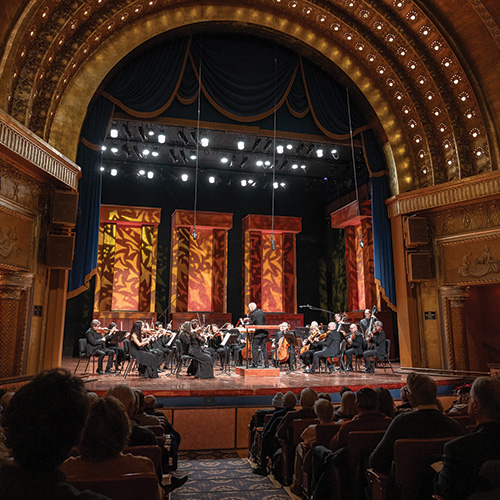
Stay for Coda: Post-Concert Conversation. Meet the featured artists and learn more about the evening’s program.


